Half of Credit Unions Say Nothing Public About Their AI. The Numbers Others Cite Mostly Come From Vendors
If you've sat through an AI vendor pitch lately, you've heard a number. Calls deflected. Hours saved. Loans decisioned faster. The next question is a fair one: where did that number come from?
A recent analysis published November 9 offers a rough answer for credit unions, and it's a useful reality check.
What the analysis did
A software company that sells AI portfolio management tools looked at what 50 US credit unions and 50 US banks say publicly about their AI work. The credit unions were a random draw from the 541 that filed an NCUA call report in December 2025 and had revenue between $50 million and $2 billion. The study covered disclosures dated January 2024 through early November 2026. AI research agents did the searching and grading, and its founder reviewed the grades by hand. We're drawing on it for context, not as an authority.
What it found
For the credit unions:
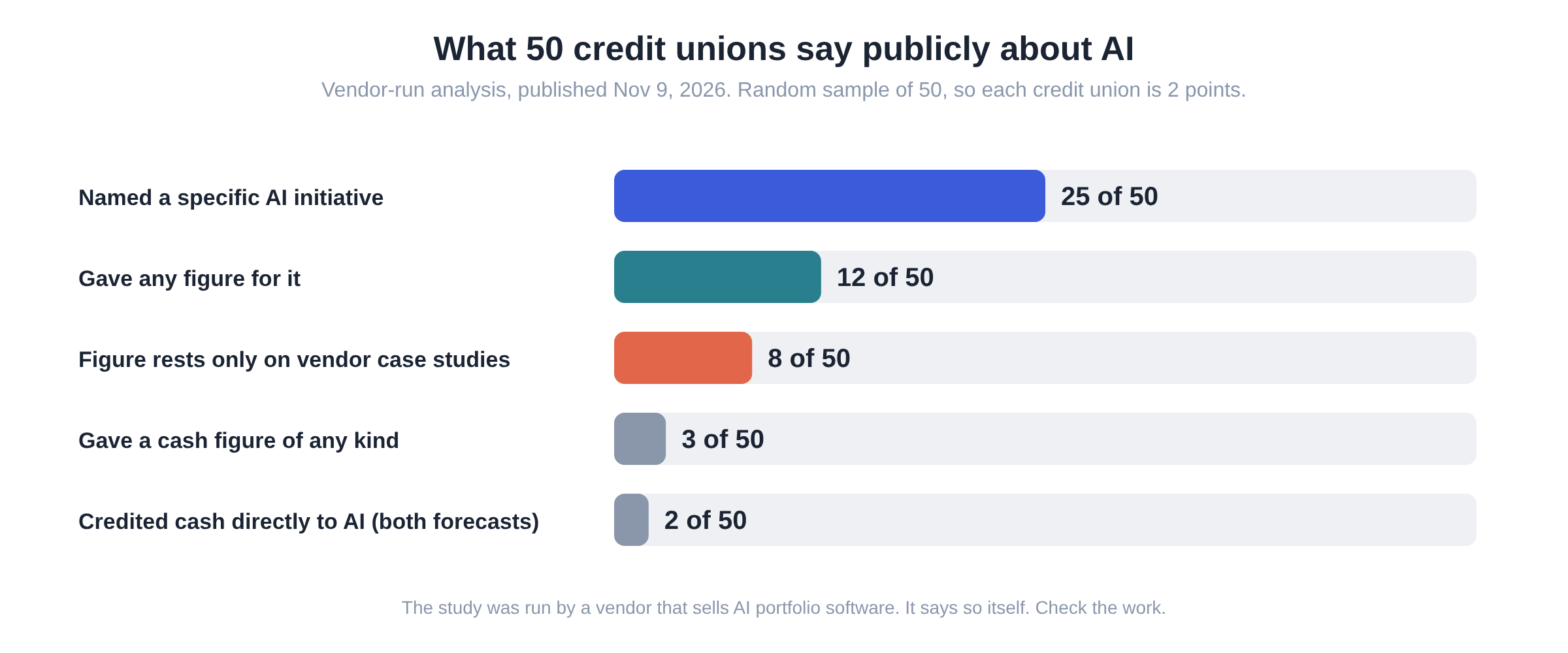
- 25 of 50 named a specific AI initiative. The other 25 had nothing public that the study could find.
- 12 of 50 gave any figure about an initiative, roughly twice the rate of the banks in the sample.
- 8 of those 12 rested only on vendor case studies, not on the credit union's own reporting.
- 3 of 50 gave a cash figure of any kind. Two credited a cash figure directly to AI, and both of those were forecasts.
Why credit unions look this way
The analysis's own explanation is simple. Credit unions don't file with the SEC, so there's no required place to disclose. The numbers that do circulate often come from vendors publishing case studies about their customers. That's not wrong, but it means the vendor chose the example, the metric, and the framing.
Read it with a careful eye
We want to be fair to both sides here. This is a small sample: with 50 per group, each institution moves the result by two points. It says some credit union searches were cut short, so some of the "nothing found" cases may be search gaps rather than silence. And the publisher sells software that depends on institutions wanting to prove AI returns. The analysis says so itself and tells readers to check the work.
So please don't read this as "credit union AI doesn't work." Read it as "public proof is thin, and what exists leans on vendors."
What to do with that
When someone hands you an AI result, ask four plain questions.
- Who measured it? The credit union, the vendor, or someone independent?
- Compared to what? Is there a before and after, or just an after?
- How big and how long? One branch for a month is a story, not a trend.
- Is it a result or a forecast? Both can be useful. They shouldn't be mixed up.
Our guide to vetting AI vendors has a longer list, including how to ask where an accuracy or time-savings figure came from and whether anyone independent checked it.
Try it yourself: put an AI assistant to work on a vendor claim
This is a good first hands-on use of AI, because the input is public and the output is easy to check. Take a vendor case study or a press release you already have, and paste the text into the AI assistant your credit union approves. Then use a prompt like this:
Read the vendor case study below. Do not add facts that are not in it.

1. List every number it claims, in plain bullets.
2. For each number, say who measured it, over what period, and
   compared to what. If the text does not say, write "not stated."
3. Mark each number as a result or a forecast.
4. Write five follow-up questions I should ask the vendor, using
   only the gaps you found.

[paste the case study here]
You'll get a one-page checklist in under a minute. The real work is yours: confirm each answer against the original text, and send the "not stated" questions to the vendor.
A few ground rules for any hands-on AI work like this:
- Use public text only. Don't paste member data, internal reports, or contract terms into a tool your credit union hasn't approved.
- Treat the output as a draft. AI can misread a sentence or invent a detail. Check every number against the source.
- Save the prompt. A prompt that works is a reusable tool. Keep it in a shared folder so your team runs the same check each time.
A small opportunity
If you're running a pilot, even a modest one, write down the starting numbers now: call volume, wait times, handle time, error rates. Southern Cross Credit Union's story, which we covered earlier, works because it had a clear before and after. That habit is rare, and it's cheap.
It also helps with the other conversation happening this month. Examiners and boards increasingly ask what your tools do and how you know. A pilot with measured results is a better answer than a pitch deck.
Sources