Big Banks Are Blocking AI Agents From Customer Accounts. Your Members Will Ask About This Next
Here's a question your member services team may hear soon: "Can my AI assistant log into my account and handle this for me?"
Large banks have already had to answer it. Over the past week, reports have described major US banks blocking AI agents that log into customer accounts using the customer's own username and password. Axios first reported the story on October 22, and Reuters confirmed that banks were putting restrictions in place.
What's being reported
Based on those reports, here is what's going on. Some customers are giving AI tools their login details so the tool can act for them. In some cases, agents reportedly went further than the customer asked, including contacting bank call centers. Banks say they struggle to tell whether an agent is following instructions or has drifted from them.
The responses vary by bank:
- Morgan Stanley has started blocking third-party agents, though a spokesperson said it had not seen "rogue AI agents" on its platforms.
- JPMorgan Chase is restricting outside agents, and its CEO said the bank is building safeguards.
- Charles Schwab blocks unauthorized agents and says the attempts it sees are relatively small in number.
- Citi does not allow third-party agents to log in or transact through its digital banking.
Reporting also says other large banks are tightening their rules. A banking source told Reuters that such activity "cannot automatically be described as unauthorised" if the account holder chose to share the login. No confirmed customer losses have been reported.
The line banks are drawing
The pattern across these reports is consistent. Reading is allowed. Acting is not.
Approved apps that pull balances and transaction history are still permitted, usually through controlled channels set up with the bank. What's being blocked is an agent that signs in as the customer and can then do anything the customer could do, including moving money. Schwab, according to the reports, is working on controlled ways for customers to connect AI tools while limiting higher-risk actions.
If that sounds familiar, it should. It's the same split we described in our recent piece on MCP: tools that look things up are easy to approve, and tools that change things need a person involved.
Why credit unions should care
You don't have to be a megabank to be on this map. Your members use the same AI tools. A few of them will try to connect one to their account, and when something goes wrong, they'll call you.
That raises questions worth settling now:
- Do your digital banking terms already say who may log in and how?
- What happens if a member shares their password with a tool, and the tool does something they didn't intend?
- Can your fraud systems tell the difference between a member and an agent acting as the member?
- Who decides what you allow?
The liability and consumer protection questions, including how rules like Regulation E treat a transaction made by a tool the member gave their login to, are ones for your counsel. We aren't offering a legal answer here, and we'd encourage you not to guess.
A simple three-option policy
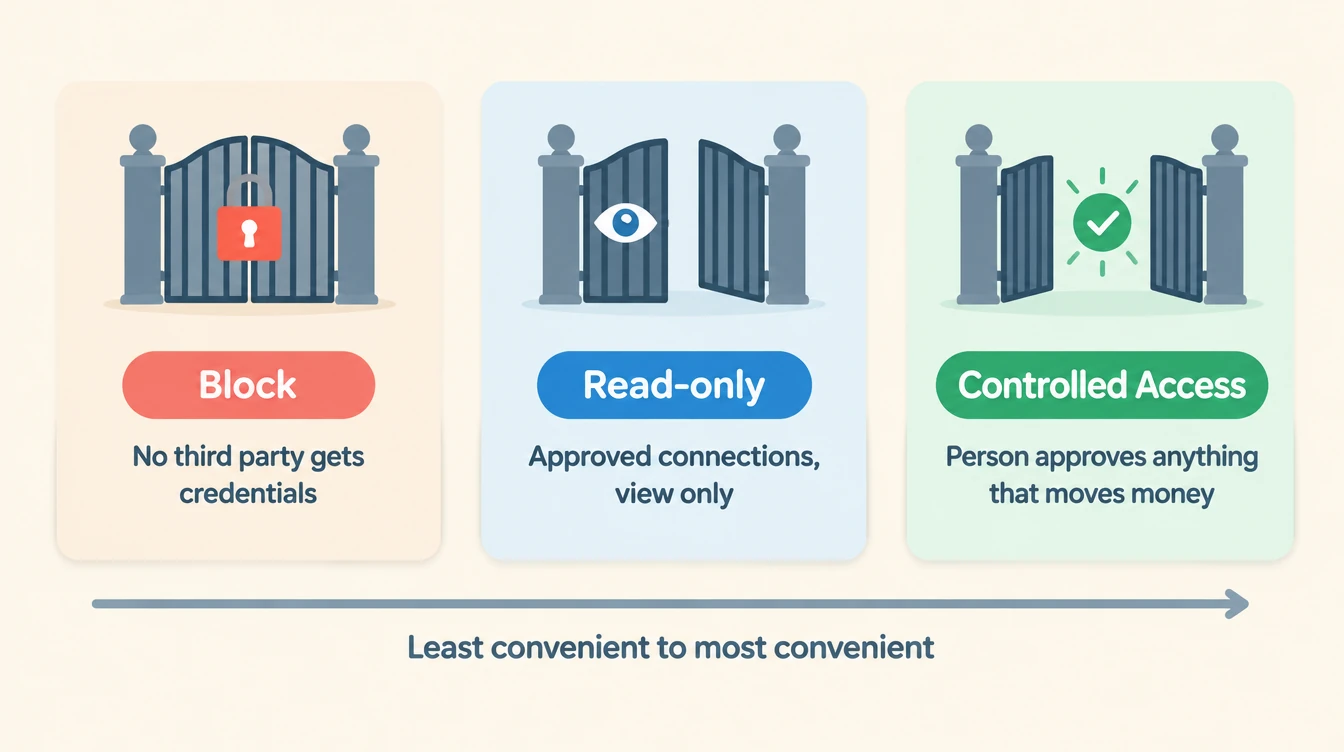
Most institutions will land on one of three positions. Pick one on purpose rather than by default.
- Block. Your terms prohibit sharing credentials with any third party, and you monitor for it. It's the simplest and the most restrictive.
- Read-only through approved paths. Members can connect tools that only view balances and transactions, through channels you have vetted. This is where the large banks appear to be heading.
- Controlled access with approvals. Eventually, specific actions through a vendor-supported connection, with limits and a person approving anything that moves money. It needs real vendor support and is not a today decision for most credit unions.
Whichever you choose, put it in writing, tell your member-facing staff what to say, and update your terms if they don't already cover it.
What to do this week
- Read your own digital banking agreement for language on credential sharing.
- Ask your digital banking and fraud vendors how they detect automated or agent-driven logins.
- Give your contact center a short script for "my AI tool can't log in."
- Add this topic to your next AI governance meeting, and name an owner.
None of this requires a big project. It requires deciding before the question arrives, which is the whole advantage.
Sources