Banks Are Rewriting Their Terms: If Your AI Agent Goes Wrong, the Loss May Be Yours. What Should Your Credit Union Say?
A few weeks ago we wrote about big banks blocking AI agents that log into customer accounts. The next chapter is quieter and, for a credit union, more useful: the banks are rewriting their fine print.
What's being reported
American Banker reported on November 2 that Wells Fargo's updated terms, effective November 24, would hold customers responsible for AI agent activity even after they tell an agent to stop, unless they can produce evidence that they did. The article called it possibly the first requirement of its kind at a bank, and it didn't say what evidence would qualify. A consultant quoted in the piece asked the obvious question: what happens if a customer does everything the bank says and still loses money?
A smaller outlet, Startup Fortune, reported on November 18 that Citi, PNC, and Citizens have also told customers that those who give a third-party AI agent access to their accounts are responsible for what it does. It says PNC changed its terms on November 18, that Citizens emailed customers the same week, and that JPMorgan Chase and Bank of America had moved in October. It also quotes Wells Fargo's agreement as treating every transaction by a customer's delegates, AI agents included, as authorized, "including those you did not want or intend." Much of that report relies on TechCrunch and CNBC for the details, so treat it as reported and check the agreements themselves. It also notes that no court has tested whether these clauses hold up when an account is drained, and that no US regulator had publicly weighed in.
The pattern is easy to see. First banks blocked the agents. Now they're settling, in writing, who owns the outcome when a member lets one in.
Why the word "authorized" matters
The reported reasoning is worth understanding even if you never write a clause like this. Under Regulation E, which implements the Electronic Fund Transfer Act, a consumer's liability for an unauthorized electronic transfer is limited, and the limit is lower when the consumer reports quickly. If a bank's terms define everything an agent does as something the customer authorized, those transactions may never be treated as "unauthorized" in the first place. That reading is the Startup Fortune author's analysis, and as far as the article says, nobody has tested it. We're not telling you how it applies to your members. That is a question for your counsel, because Regulation E applies to credit unions as well as banks.
Why a credit union should care
Your members use the same tools. Some will paste a login into an AI assistant this holiday season, because it's convenient and nobody told them not to. When something goes wrong, they'll call you, not the AI company.
Whether a member can be held responsible for a transaction made by a tool they gave their login to is a legal question that touches consumer protection rules. We aren't answering it, and we'd encourage you not to guess. It belongs with your counsel.
What you can do now, without a lawyer in the room, is decide what questions your terms need to answer.
Five things your terms should settle
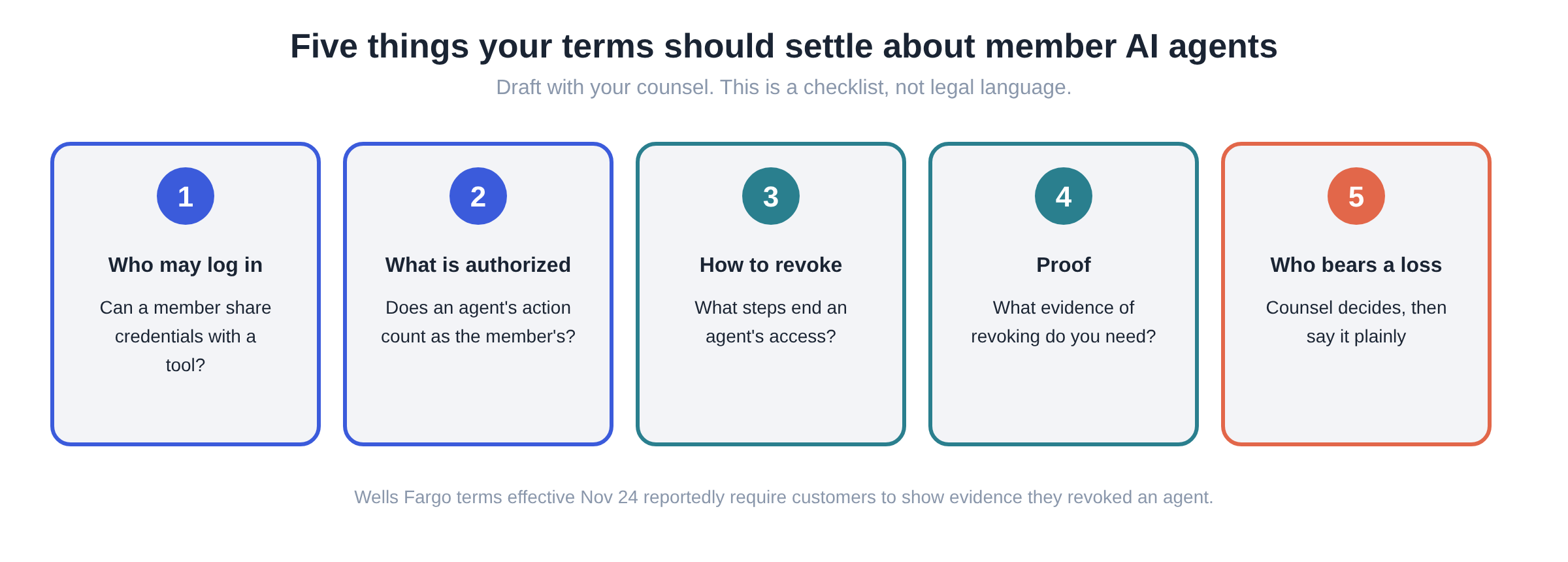
- Who may log in. Does your agreement say whether a member can share credentials with a third-party tool? If it's silent, that silence is a decision.
- What is authorized. If a tool acts with a member's login, is that the member's action? Say how you'll treat it.
- How to revoke. If a member wants to cut off an agent, what exactly do they do? Changing a password? Contacting you? Both?
- Proof. If you ask a member to show they revoked access, what counts? Make it something a normal person can actually produce.
- Who bears a loss. This is the one for counsel. Whatever the answer, say it in plain words, not buried on page nine.
What members can do now
If your members ask, a few plain points are reasonable to share, and your compliance team can adjust them:
- Don't give a password to an AI assistant or any tool you don't fully trust. Bank of America reportedly asked customers not to, in late October.
- Prefer tools that say they are read-only, meaning they can see balances but can't move money.
- Prefer tools that connect through a permission you can switch off, instead of ones that log in as you.
- Know how to cut off access, and keep a record of when you did.
A member-friendly angle
Large banks are using their terms to push risk onto customers. Credit unions have a different relationship with members, and it's reasonable to ask how that should show up here. A clear, plain-language policy with a simple way to revoke access, and a human to call, could be a point of difference. That's a judgment for your board, and we're only raising it.
This week
- Read your digital banking agreement for language on credential sharing and third parties.
- Write one plain sentence on what you'd tell a member who asks, "Can I let my AI assistant log in?"
- Give your contact center a short script and a place to send questions.
- Ask your fraud team whether they can tell automated logins from a member's own.
- Put the topic on your next governance meeting agenda, and name an owner.
Try it yourself: compare agreements with an AI assistant
This is a good hands-on use of AI for a compliance or data analyst, because the input is public text. Save the relevant sections of three public bank agreements and paste them in with a prompt like this:
Below are sections of three public account agreements. For each
one, quote the exact sentences about (1) sharing login credentials
with third parties, (2) whether actions by third-party tools are
treated as authorized, (3) how to revoke access, and (4) who bears
losses. If a document does not address one of these, write
"not addressed." Do not interpret or give legal advice.

[paste text, labeled A, B, C]
Then read the quotes against the originals. The point is to put the language side by side, not to get an answer. Use public text only, and treat any summary as a draft for your counsel.
This is general information, not legal advice. Your counsel and compliance team should confirm what applies to your credit union.
Sources