A Fed Governor Warns AI Agents Could Speed Up Bank Runs. Here Are Three Questions for Your ALCO
Most of the AI agent conversation is about fraud, logins, and liability. On Monday, a Federal Reserve Governor added a different angle: deposits.
What was said
On November 16, Fed Governor Michael Barr gave a speech in Milan titled "Some Potential Financial Stability Implications of Artificial Intelligence." Among other things, he said major banks are reporting AI agents attempting to take actions in retail customer accounts, and that the bank's ability to verify authenticity, consent, and alignment with customer instructions is lacking.
For controls, he pointed to strict authentication, explicit consent verification for specific actions, and technical controls that limit what agents can do.
Then he raised the part that stood out. AI agents could move money quickly to chase yield or in response to stability signals. That could potentially accelerate runs that unfold in minutes, and he noted such runs could outpace traditional liquidity management and regulatory intervention timelines.
What this isn't
It's a speech, not a rule or an exam expectation. Barr was talking about the financial system, mostly in a bank context, and the NCUA wasn't part of it. We can't say how or whether it reaches credit unions directly.
But the question underneath it is a fair one for any institution that funds itself with member deposits: if money starts to move faster and more automatically, how quickly would you know?
Why a credit union should care
Credit unions have a particular exposure. Members are often rate-sensitive, especially with certificates maturing and competitors posting new offers. If more members hand financial tasks to an assistant that's told to find the best rate, the pattern of moves could change. We don't know how much, and anyone who gives you a number is guessing. The point is to be ready for a faster rhythm, not to predict one.
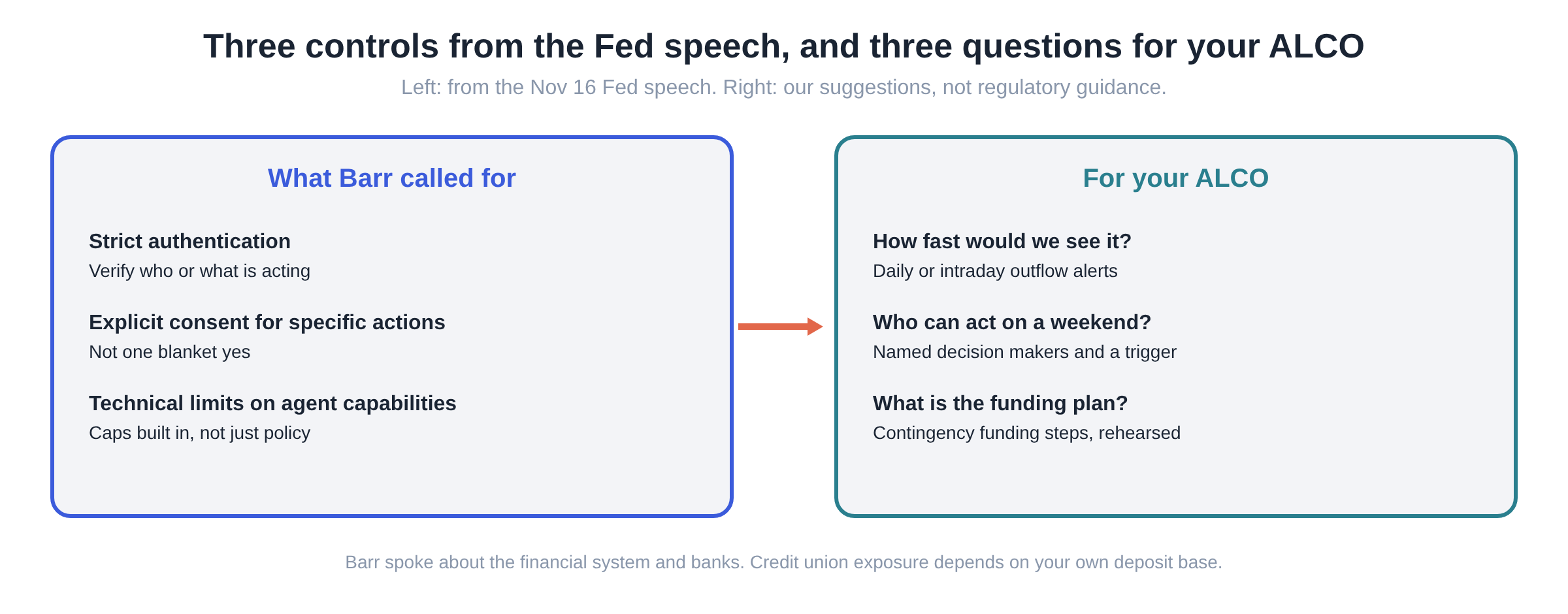
Three questions for your ALCO
These are our suggestions, not regulatory guidance.
- How fast would we see it? If net outflows started to run well above normal, how soon would someone on your team know? Daily is common. Intraday alerts for share drafts and certificate early withdrawals are less so.
- Who can act, and when? Name the people who can make a funding decision on a weekend, and the threshold that triggers a call. A plan that needs someone to find the right person on Saturday is a slow plan.
- What is the funding plan? Know your contingency funding steps, which sources you'd draw on first, and when you last rehearsed them.
None of these requires AI expertise. They're ordinary liquidity questions, asked at a faster speed.
Try it yourself: a deposit outflow alert
If you work in data, this is a practical project. The goal is a simple view that flags when net flows are unusual against your own history.
Ask your approved AI assistant for help drafting the logic with a prompt like this, using a table layout description and not real member data:
I have a table of daily deposit totals by product type with these
columns: [paste column names and definitions]. Write SQL that
calculates daily net change, compares it with the trailing
60-day average and standard deviation, and flags days that are
more than 2.5 standard deviations below average. Explain each
step and list your assumptions. Do not invent columns.
Then test it. Run it on a quarter of history you know well and see whether it flags the days you remember as unusual, and whether it flags too many. Thresholds like 2.5 are a starting guess, not a standard, and the right setting is yours to tune. Reconcile the daily totals to your general ledger before anyone trusts an alert. Our recent post on checking AI-written SQL has a five-step routine for this.
A reminder on the other date
One more date worth knowing: the agencies extended the comment period on the proposed third-party risk management guidance. Comments are now due December 16, instead of November 16, according to an NCUA release dated November 13. If you meant to comment and ran out of time, you have a bit more.
The takeaway
The agent story keeps widening. It started with logins, moved to who pays when something goes wrong, and now includes how quickly money might move. A credit union that can answer "how fast would we know, and who decides" is in a good spot for all three.
Sources