How Credit Unions Are Modernizing Their Data Stack, One Step at a Time
Every credit union AI conversation eventually lands on the same unglamorous topic: the data. Surveys keep saying so. In the PYMNTS Intelligence tracker from January, more than 8 in 10 credit union leaders cited integration with existing systems as a major obstacle, and data quality, governance, and connectivity were the main constraints.
"Modernizing the data stack" sounds like a multi-year project with a large invoice. It does not have to be. Here is a way to think about it in steps.
Why the core is not enough
Cores are built to run operations: post transactions, keep balances right, close the day. They are not built for analysis. The Filene Research Institute makes this point in a 2026 post by Lamont Black of DePaul: requests queue up, analysts become bottlenecks, decision makers wait, and analytics should move out of the core into platforms the credit union controls. In its words, the challenge is not that credit unions lack data, it is that data remains siloed, mediated, and slow to activate.
A five-step ladder
This framing is ours, informed by that Filene commentary. It is not a standard, and your path may look different.
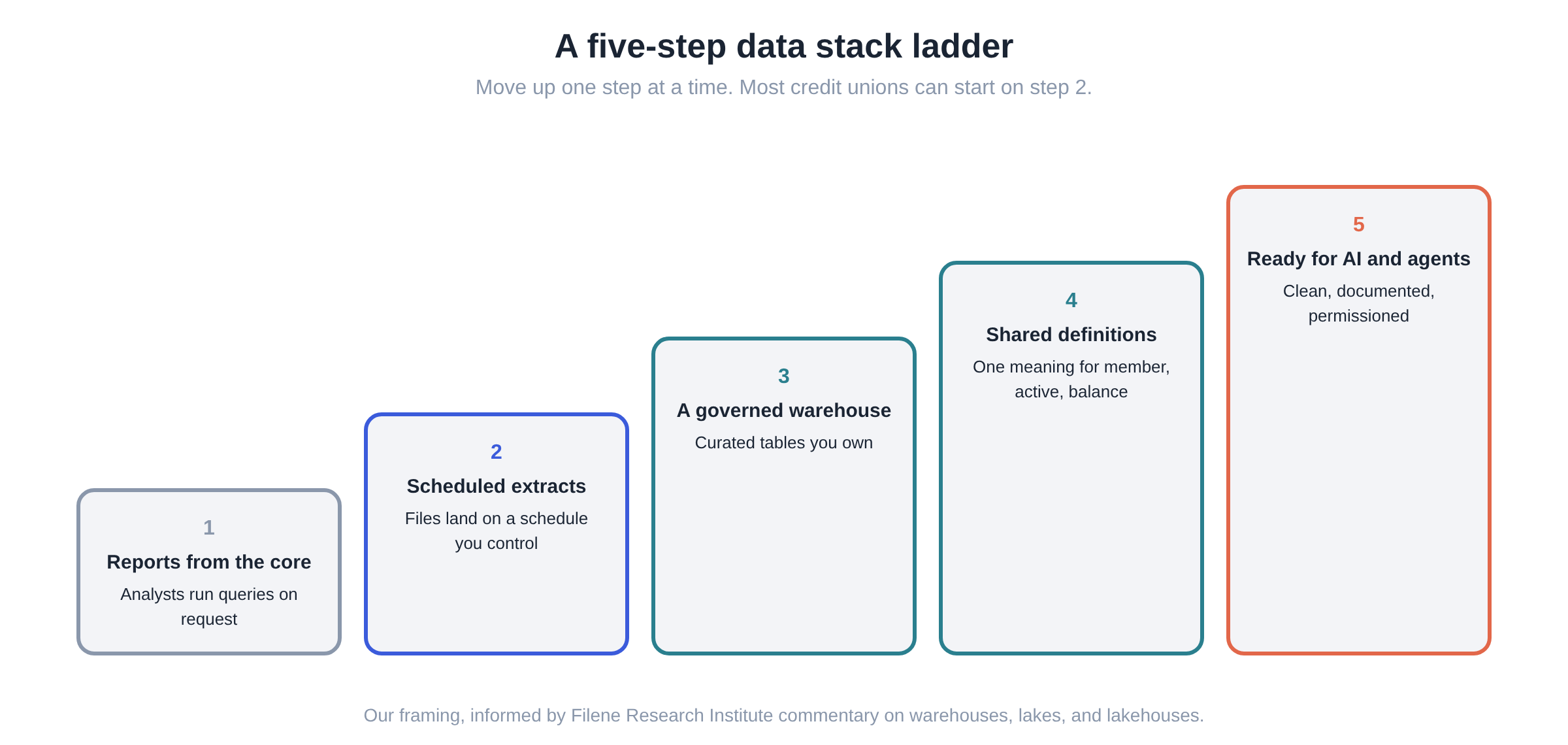
Step 1: Reports from the core. Analysts run queries when asked. Everyone starts here. It works, but every answer depends on one person and one system.
Step 2: Scheduled extracts. Files land on a schedule you control, such as a nightly export of members, accounts, loans, and transactions to a secure location. This is the step with the best return for the least effort, and most credit unions can start here.
Step 3: A governed warehouse. The extracts load into curated tables you own, in a warehouse, lake, or lakehouse. Access is permissioned, and changes are logged.
Step 4: Shared definitions. One meaning for "member," "active," and "balance" across the whole credit union. This is where many projects quietly stall, because the argument is about definitions, not technology.
Step 5: Ready for AI and agents. The data is clean, documented, and permissioned, so tools can read it safely. The Filene post also describes agents that monitor data pipelines and escalate to humans within defined boundaries, which only works when the foundation underneath is solid.
Why extracts before live integration
A view we hold at Magnus: ingesting extracts you already produce is usually a better first move than wiring directly into the core. Live core connections tend to need your IT and information security teams and often take months. A file that lands overnight needs far less. You give up real-time data, which most analysis does not need, and you keep your core vendor relationship simple. If a specific use case needs live data, add it later.
What to do in the next 30 days
- Inventory your extracts. What reports and files already leave the core each day or week, and who uses them?
- Pick three tables. Members, accounts, and transactions are common. Start small.
- Write down five definitions. Member, active member, balance, delinquent, and new account. Get the decision makers in one room.
- Name an owner. Someone owns data quality, with time set aside for it.
- Ask your core provider what bulk export options, formats, and fees apply, in writing.
Governance from day one
Moving data raises real questions. Who can see what? Where is it stored? What happens to it when a vendor changes? Keep an access list, a data dictionary, and a retention rule from the start. Also check your third-party risk process, since a cloud warehouse is a new vendor relationship. The agencies' proposed third-party risk guidance is open for comment through December 16.
Try it yourself: draft a data dictionary with AI
This is a good hands-on project for a data analyst and uses only metadata, not member data. Export the column names and data types of three tables, then use an approved AI assistant with a prompt like this:
Below are column names and data types from our member, account,
and transaction tables at a credit union. For each column, write a
one-sentence plain-language definition and flag columns whose
meaning is ambiguous. For ambiguous ones, list the question we
should ask the business owner. Do not guess business rules.

[paste column names and types]
The flagged questions are the valuable output. They become the agenda for your definitions meeting at step 4. Have someone who knows the core check every definition before it goes in a shared document.
Where it goes wrong
- Boiling the ocean. Start with three tables and one report that matters.
- Skipping definitions. Two dashboards showing different member counts will end trust faster than any outage.
- No owner. A data stack without a named owner decays.
- Buying tools first. Tools do not settle definitions or ownership.
The takeaway
Becoming ready for AI looks a lot like becoming ready for good reporting. Get your data out on a schedule, define your terms, protect access, and add the smart tools last. Most credit unions can start this month.
Sources
- Data-Driven Finance: From Core Systems to Intelligent Agents, Lamont Black, April 22, 2026 (Filene Research Institute)
- Critical Moment: The AI Imperative for Credit Unions, January 2026 Credit Union Tracker (PYMNTS Intelligence)
- Agencies extend comment period on proposed third-party risk management guidance (NCUA)