MCP Is the USB-C Port for AI. Here's What It Means for Your Credit Union
If you've been to a vendor demo this year, you've probably heard a new three-letter term tossed around like everyone already knows it. MCP. As in, "Of course we have an MCP server."
Nobody stops the meeting to ask what that means. So let's do it here, quietly, without the jargon.
What MCP is, in one sentence
MCP stands for Model Context Protocol. It's an open standard for connecting an AI assistant to the systems where your data and tools live. Anthropic introduced it in late 2024.
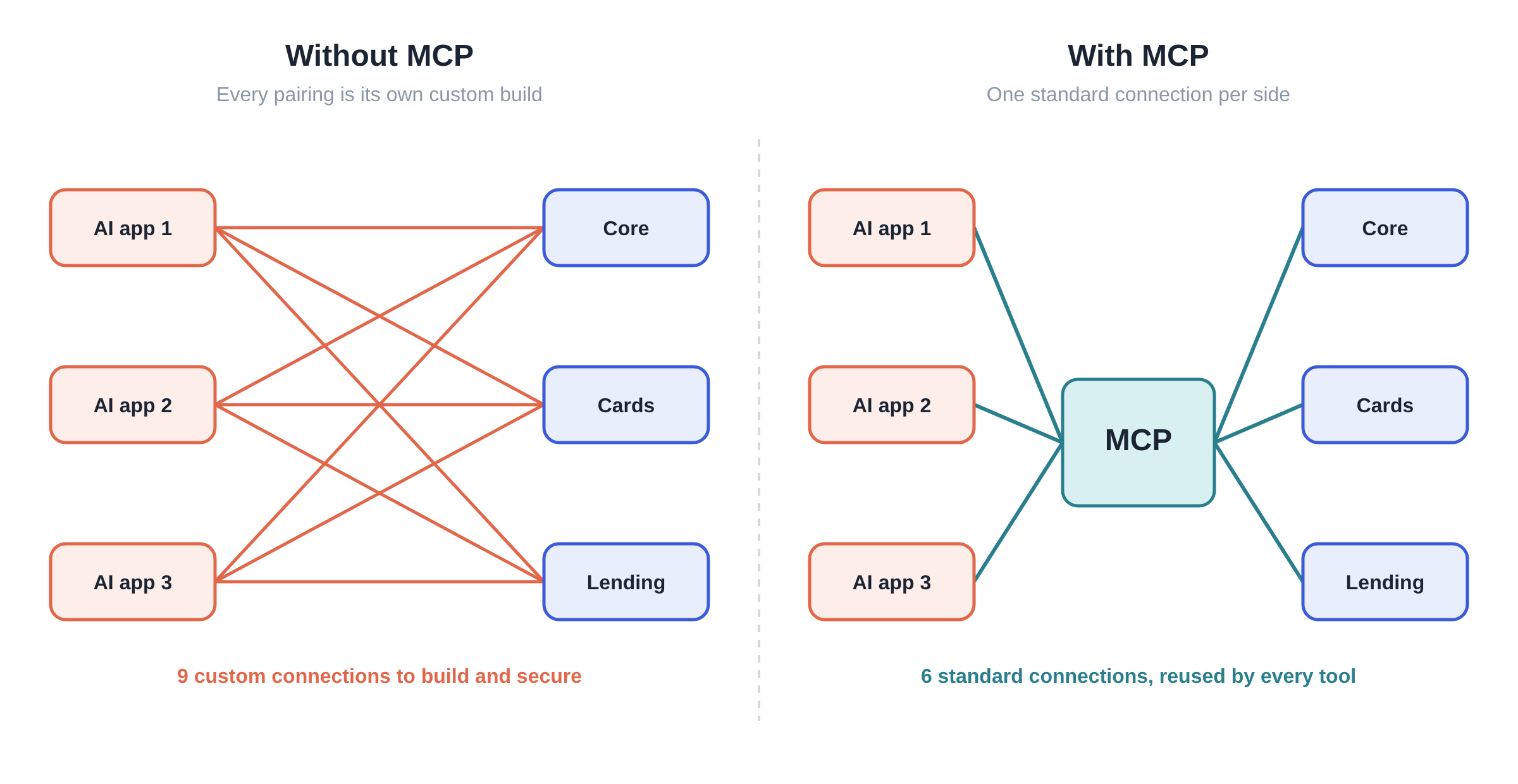
The easiest picture is USB-C. Before it, every device had its own charger. Now one kind of plug works across a lot of gear. MCP is trying to be that plug for AI. Instead of building a custom connection between every AI tool and every system, a vendor builds one MCP server, and any AI app that speaks MCP can use it.
Wait, isn't that just an API?
Fair question, and the answer is "not quite, but they're related."
An API is a menu written for programmers. It lists every dish, in exact notation, and someone has to write code to order from it. Every vendor's menu looks a little different, so every new connection means new custom work.
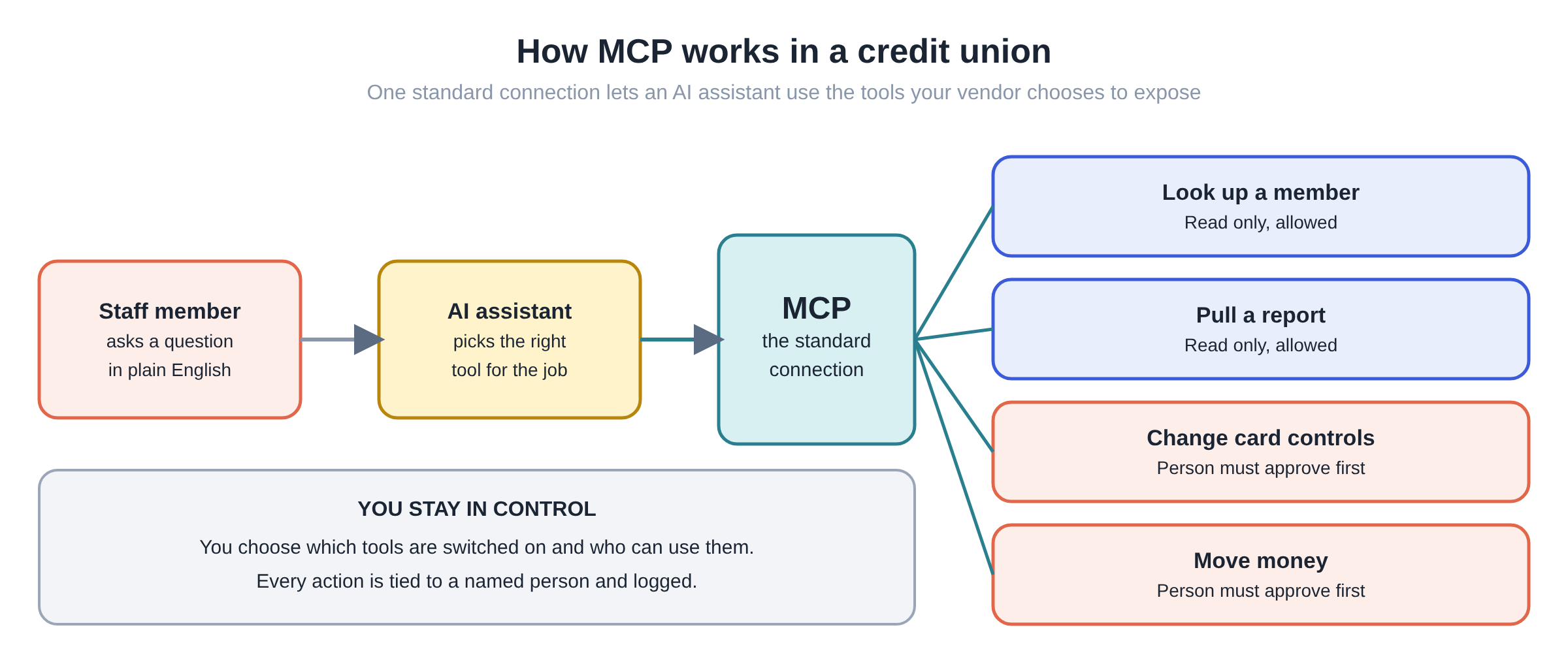
An MCP server sits on top of those menus and describes what's available in a way an AI can read on its own. The assistant can ask, "What can you do?" and get back a list of tools: look up a member, check a card status, pull a report. Then it can pick the right one for the job.
Here's the short version:
An MCP server usually doesn't replace the API. It wraps it. The API is still doing the work underneath.
Why vendors are doing this now
Three things lined up.
First, the standard got serious backing. On December 9, 2025, Anthropic donated MCP to a new group called the Agentic AI Foundation, which sits under the Linux Foundation. It was co-founded by Anthropic, Block, and OpenAI, and supported by Google, Microsoft, and AWS, among others. When competitors agree on one plug, vendors stop worrying about betting on the wrong one.
Second, it spread fast. At the time of that announcement, there were more than 10,000 active public MCP servers, and the main software development kits were being downloaded more than 97 million times a month. ChatGPT, Gemini, Microsoft Copilot, Cursor, and VS Code all support it.
Third, financial technology vendors started shipping. Nymbus, which serves banks and credit unions, launched an MCP server on April 10, 2026, with 19 tools covering things like customer lookup, account management, money movement, and debit card controls. The institution chooses which tools are switched on, which roles can use them, and where a person has to approve the action. Blend has an MCP server for its lending platform in beta, according to an industry research roundup. And Cotribute, a vendor focused on credit unions and community banks, offers a design partner program for its MCP Connect tools, though its performance claims come from the vendor and we haven't verified them.
One honest caveat. When we looked, we did not find a public MCP announcement from the largest core providers. Their recent materials describe their existing API programs instead. That could change quickly, so it's worth asking your core rep directly.
What it means for a credit union
Here's the upside. Today, getting an AI tool to work with your systems often means a custom project, and most credit unions don't have the staff for that. MCP shrinks the work. If a vendor you already use has an MCP server, you might be able to let an approved AI assistant help your staff with real tasks without building anything.
Now the part we want you to take seriously. An AI that can only talk is one thing. An AI connected through MCP can do things: look up members, change card settings, move money. That's the line we drew in an earlier post between AI that recommends and AI that decides. MCP is what makes the second kind easy to build.
It also isn't magic on security. A security expert interviewed by Help Net Security put it bluntly: MCP is a protocol, not a product, and it doesn't handle things like authentication, audit trails, or rate limiting by itself. Those are on the vendor and on you. The same expert also pointed to a risk called a "rug pull," where a server that looked safe on day one later changes what it tells the AI to do, because clients get the latest description every time they connect.
How to bring MCP into your workflow without a mess
You don't need a big program. Start small and keep the guardrails on.

- Pick one boring task. Something like summarizing a member's recent service history for a staff member, or drafting a report from data you already have. Not money movement.
- Start read-only. Turn on tools that look things up before tools that change things. If a vendor can't separate the two, that tells you something.
- Use named people, not shared logins. Every action should trace back to an individual, so you can answer "who or what did this?" later.
- Keep an approved list. Decide which AI apps and which MCP servers are allowed. Staff trying unapproved ones on their own is the new version of shadow IT.
- Require a person for anything that moves money or changes a record. Our decision tree for vetting AI tools gives the same advice for the agentic category.
- Turn on logging, and look at it. Logs nobody reads don't protect you.
- Write it down. One page per server: what it can do, who can use it, what data it sees, who owns it.
Questions to ask any vendor who says "we have an MCP server"
- Is it live in production, or in beta?
- Which tools does it expose, and can we switch off each one individually?
- Is access tied to individual users and roles?
- What gets logged, and can we get those logs?
- How do you tell us when the server's tools or descriptions change?
- Who is responsible if the AI uses a tool incorrectly?
These pair naturally with the vendor questions in our earlier guide to vetting AI vendors. And because an MCP server is part of the vendor relationship, it belongs inside the third-party risk work regulators are already asking for, including the interagency proposal from September that the NCUA co-issued.
The bottom line
MCP is a real shift, not a buzzword. It makes connecting AI to your systems cheaper and faster, which is exactly why it deserves a little more care, not less. Pick one small use, keep a human in the loop, and ask your vendors the plain questions. You'll be ahead of most of the industry.
Sources
- Donating the Model Context Protocol and establishing the Agentic AI Foundation (Anthropic)
- Nymbus Launches Industry-Leading, Secure MCP Server for AI-Driven Core Banking Actions (CU Broadcast)
- Sector Spotlight: AI Agents and Connectors for Banks and Credit Unions (CCG Catalyst)
- Cotribute MCP Connect for Digital Banks and Fintechs (Cotribute)
- Treating MCP like an API creates security blind spots (Help Net Security)
- FIS, Fiserv, and Jack Henry AI Integration Guide (go.ai)
- Agencies seek comment on proposed third-party risk management guidance (Federal Reserve)