Chase, Microsoft, and a Data Center: What This Month's Outages Teach Credit Unions About Resilience
It's been a rough month for things that are supposed to just work.
On November 12, Microsoft had a global outage. On November 16, customers of several large banks couldn't get into their accounts. And two months ago, a data center problem took dozens of credit unions offline. None of those three was blamed on a cyberattack. All of them were reminders of something that's easy to forget when systems are quiet.
What happened
Microsoft, November 12 to 13. According to Al Jazeera's reporting, the outage began around 16:00 GMT on Thursday and hit Outlook hardest, with Teams and Copilot partly affected. It was still unresolved Friday morning in Europe, and the disruption reached integrations that other companies rely on, including AI services from OpenAI and Anthropic. Microsoft said there was no indication of malicious activity. No root cause had been published at the time of the report.
Chase and others, November 16. The Associated Press reported that thousands of customers had trouble reaching online accounts at several large banks and at Zelle. Chase's spokesman said the cause was a software bug in an on-premise hardware system and said it wasn't a cyberattack or a systemic issue. The AP said the trouble centered on Chase customers and on people at other banks trying to transact with Chase. Bank of America and Citigroup said their own services weren't affected, and Zelle's operator said the network was operational and the delays came from member institutions. In other words, one institution's problem showed up as another institution's customer complaint.
23 credit unions, September. American Banker reported that 23 credit unions in 14 states, together holding about $2.56 billion in assets and roughly 200,000 members, lost service when a data center problem hit their core provider's environment. The headline attributes it to overheating, though the provider and data center operator had not confirmed the cause in the article. The article says the core provider had not named the data center, and that the network operator carrying the provider's production systems had not said whether one of its facilities lost cooling. One of the smallest credit unions, in Louisiana, closed its doors during the outage.
A longer one. In September, Hilltop Bank in Wyoming was offline for about a week after a cyber incident. Seven of its eight offices were open but only for a narrow set of transactions, and debit cards were capped at $1,000 a day. That's a useful picture of what "degraded" can look like for a member.
The pattern
Look at those four events together and a few things stand out.
- Hidden dependencies. A Microsoft problem reached other companies' services. A Chase problem reached other banks' customers. Your members don't see the chain. They see your name.
- Cause isn't the point. Software bug, overheating, or an attack: the member experience is the same. They can't pay, transfer, or check a balance.
- Not always a hack. It's tempting to plan for the dramatic scenario. Many outages are mundane.
- Communication is part of the fix. American Banker's November 17 coverage of the Chase outage, which it said came amid glitches affecting air travel and Microsoft, quoted technology experts saying banks should brush up on public communication skills. We only saw the summary of that piece, but it matches what members notice first: whether you said anything.
- Small institutions feel it too. The credit unions that went offline had no say in where their provider's equipment sat.
A regulatory footnote
The American Banker piece on the credit union outage noted that nine months earlier, the NCUA had told a federal council it might no longer need the authority to examine vendors like the one involved. We're only repeating what was reported, and we can't say what, if anything, will change. But it's a reminder that, in practice, a lot of the checking on your vendors falls to you.
Three questions to ask this week
- What would members experience in the first hour, the first day, and the first week? Not what the system would do. What members would see.
- Which vendors does your vendor depend on? You may not be able to see the whole chain, but you can ask for the data center locations, the backup arrangements, and the last time they tested a failover.
- Have you practiced? A plan nobody has rehearsed is a guess. A short tabletop exercise reveals gaps faster than another document.
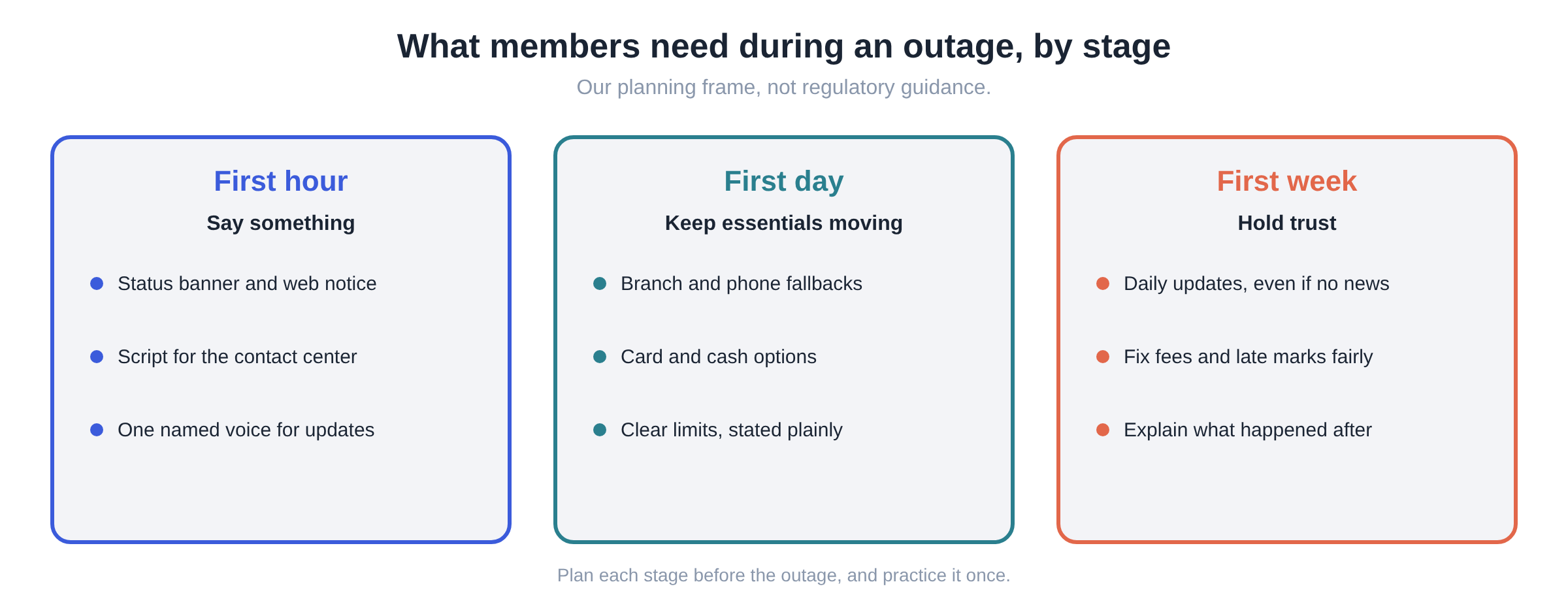
What to put on the one-page outage plan
- A dependency list. Your core, digital banking, card processor, payment networks, identity and email, and who hosts what.
- Named decision makers, with backups, and how to reach them when email is down.
- Member messages, drafted in advance. A status banner, a phone script, and a social post, with blanks for time and cause.
- Manual options. What can staff do at a branch without the core? What are the daily limits? Write them down.
- Fairness rules. How you'll handle late fees, overdrafts, and missed payments caused by an outage you didn't create.
- A review habit. After any incident, big or small, write down what you learned.
Notice that one item on the list, email, is exactly what failed for many Microsoft customers. Your plan has to work when your usual tools don't.
Try it yourself: turn a vendor list into a dependency map
This is a good hands-on project for a data or IT analyst, and it uses information you already have. Export your vendor list, with each vendor's name and what it does, into a plain text list. Use an approved AI assistant and a prompt like this:
Below is a list of our vendors and what each does. For each one,
list what members or staff would be unable to do if it were down
for 24 hours. Group the results by member-facing impact (high,
medium, low). If the information is not enough, write "unknown"
and list the question we should ask the vendor.
Do not guess technical details.

[paste vendor list here]
Treat the output as a first draft. It won't know which vendors share infrastructure, and the "unknown" lines are the most useful part, because they're your vendor questions. Keep contract terms and anything confidential out of the tool, and check the result with your IT team.
The takeaway
Resilience isn't about preventing every failure. It's about what your members experience, and what you say, when a failure comes. The credit unions that handle outages well tend to be the ones that decided in advance what "good enough" looks like for the first hour.
Sources
- Microsoft hit by global outages: what happened and why (Al Jazeera)
- A technical issue at JPMorgan Chase triggers online banking delays across major US banks (Associated Press via OPB)
- Thousands report online outages at major US banks (Al Jazeera)
- Overheated data center knocked 23 credit unions offline (American Banker)
- As tech crashes mount, how can banks respond? (American Banker)
- Wyoming bank has been offline a week due to cyber incident (American Banker)