Pseudonymizing Member Data: What It Is, Why It Matters, and Where It Stops
Every credit union has the same quiet problem. The people who need to analyze member data are not the people who need to know who the members are. A data analyst studying certificate maturities does not need a name. A vendor testing a model does not need a Social Security number. An AI assistant helping draft a query does not need anyone's address.
Pseudonymization is the habit of separating those two things. This post explains what it is, why it matters now, and where it stops working. Next on the schedule is a hands-on build.
What it is
NIST's report on de-identification, NIST IR 8053, describes pseudonymization as replacing the names and other information that directly identifies a person with pseudonyms. Done consistently, it still lets you link records that belong to the same person across tables, because the same member always gets the same pseudonym.
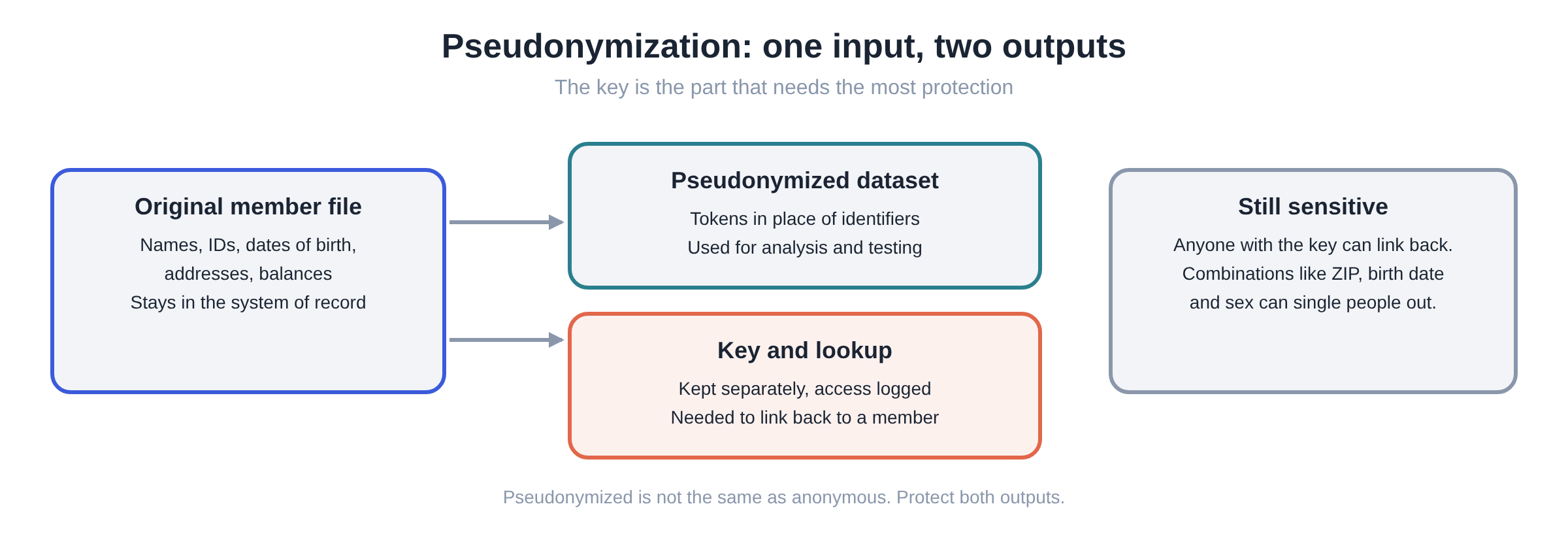
The European definition, which is useful even though it is not a US rule, puts the idea in two parts: the data can no longer be attributed to a specific person without additional information, and that additional information is kept separately and protected. The UK regulator describes the result as two outputs from one input: the pseudonymized dataset, and the additional information that can tie it back.
That second output is the part people forget. The key, or the lookup table, is as sensitive as the original data.
What it is not
It is not anonymization. NIST notes that pseudonymization can often be reversed, either because a table links the original identities to the pseudonyms, or because the method used is known or can be discovered. A pseudonymized file is still member data and should be handled that way.
It is also not a replacement for access controls, encryption, or vendor oversight. It is one layer that makes the other layers matter less when something goes wrong.
Why it matters for a credit union
- Less exposure when data moves. Every time a file goes to an analyst, a consultant, a vendor, or an AI tool, it is a chance for member information to end up somewhere you did not intend. A file with no names or account numbers is a smaller problem if it is mislaid.
- It fits the safeguards you already have. The NCUA's Guidelines for Safeguarding Member Information (Appendix A to Part 748) ask credit unions to assess risks based on the sensitivity of member information, and to consider measures such as access controls, encryption, and oversight of service providers. We did not find the word pseudonymization in those guidelines, so this is our reading, not an NCUA expectation. But using less identifying data for work that does not need identity is consistent with that risk-based approach.
- It makes AI use easier to defend. If a model or a tool never sees who a member is, the risk conversation with your governance committee gets simpler.
- It makes sharing practical. Peer comparisons, vendor proofs of concept, and training datasets all become possible without exposing identities.
Why it is easy to get wrong
Three lessons from the research are worth knowing before you build anything.
1. A plain hash is not protection. NIST describes a 2014 case in which New York City released taxi trip data after replacing medallion and license numbers with a one-way hash. People found the method and reversed it by hashing every possible number and matching the results. When the possible inputs are limited, like member numbers, an unkeyed hash can be undone the same way. A keyed method, where only you hold the secret, avoids this.
2. The other columns can identify people. Latanya Sweeney's well-known study found that 87.1% of the US population was likely to be uniquely identified by the combination of gender, date of birth, and ZIP code. A later replication by Golle using census data found fewer people uniquely identified, though the combination still singled out a meaningful share. The point is not the exact number. It is that removing names is not enough if birth date and ZIP code remain. The fix is to generalize those fields, such as an age band in place of a birth date and a three-digit ZIP, and to check that no combination is too rare.
3. Consistency cuts both ways. NIST notes that using the same pseudonym across multiple datasets makes linking easier, which is useful for analysis and also useful to someone trying to re-identify people. Use different keys or tokens for different purposes when you do not need records to link.
A simple way to sort your columns
- Direct identifiers. Name, address, phone, email, Social Security number, account number. Drop them or replace them with a token.
- Quasi-identifiers. Date of birth, ZIP code, branch, occupation, join date. Generalize them, and check group sizes.
- Everything else. Balances, product types, transaction categories. Keep what the analysis needs.
- Free text. Notes, call summaries, memo fields. These often contain names and details. Treat them as identifiers unless you have cleaned them.
Questions for your next governance meeting
- Who holds the key, and where is it stored? It should not sit beside the data.
- Who can re-identify a record, and is each use logged?
- Which projects get pseudonymized data by default, and which need an exception?
- What are the rules for AI tools and vendors?
- Does your vendor contract say anything about how they handle data you send?
Try it yourself: classify your columns in 15 minutes
This exercise uses only column names, not member data. Export the column list of one extract your team shares often, then use an approved AI assistant with a prompt like this:
Below are the column names from a credit union member extract.
For each column, classify it as: direct identifier,
quasi-identifier, sensitive but not identifying, or other.
Explain your reasoning in one sentence. If you are unsure, write
"unsure" and list the question I should ask the data owner.
Do not assume anything about the contents.

[paste column names]
Treat the output as a first draft and check it with your compliance team. The "unsure" lines are the useful ones. They tell you which fields need a decision from a person.
This is general information, not legal advice. Your counsel and compliance team should confirm what applies to your credit union, including any state privacy laws.
The takeaway
Pseudonymization is not a magic shield. It is a discipline: take identity out of the working copy, keep the key somewhere safer, and check that what is left cannot easily point back to a person. Our next post builds it in Python, with tested code.
Sources
- De-Identification of Personal Information, NIST IR 8053 (NIST)
- Simple Demographics Often Identify People Uniquely, Latanya Sweeney (Carnegie Mellon University Data Privacy Lab)
- Revisiting the Uniqueness of Simple Demographics in the US Population, Philippe Golle (Stanford)
- Appendix A to Part 748, Guidelines for Safeguarding Member Information (eCFR)
- Pseudonymisation (UK Information Commissioner's Office)