Your Regulator Is Building AI Tools. Here's What That Could Mean for Your Next Exam
We spend a lot of time on how credit unions should examine their vendors' AI. This week there's a mirror image worth a look: how regulators plan to use AI on you.
Two pieces of news point the same way. The NCUA's proposed budget includes money for an AI strategy, and the OCC has told its bank examiners how to ask about AI. Neither is a new rule. Both are worth knowing about.
What the NCUA has proposed
On October 27, the NCUA released its proposed combined budget for 2027: $325.4 million, up 2.9 percent. Buried in the budget justification is a line about technology. The agency plans to set aside $4.3 million, out of a $16.0 million Reorganization and Technology Investment Fund, to develop a "forward-looking super intelligence/artificial intelligence (SI/AI) strategy." The document describes the goal as using SI/AI-powered tools for "future supervision, analytics, and fraud detection."
The budget also mentions deploying SI/AI and advanced analytic tools across the agency, and says new staff positions will be assigned to areas including "SI/AI implementation and cybersecurity enhancements."
What we don't know
Quite a lot, and we want to be upfront about it. The budget is a plan for spending, not a description of how exams will change. As far as we can tell from the budget documents, the NCUA hasn't announced which tools, which data, which vendors, or how it would evaluate them. A strategy is a first step. It isn't a new exam procedure, and it doesn't change any rule you operate under.
So please don't read this as "AI exams are coming Monday." Read it as "the agency is investing in this, so it's worth being ready for the conversation."
What the OCC told its examiners
Here's the part that makes a useful preview. On November 4, Reuters reported that the OCC issued first-of-its-kind guidance for examiners on how to probe banks' AI use. It isn't legally binding the way a rule is, and it applies to banks, not credit unions. But it shows how a federal supervisor is thinking. According to the report:
- AI isn't treated as a separate kind of risk. It's looked at alongside other risks.
- Banks aren't expected to set a separate risk framework just for AI.
- The focus is on the consequences of AI-driven mistakes, not on how sophisticated the model is.
- A simple AI agent that's allowed to start transactions may be riskier than a sophisticated internal model.
- Higher-risk uses may call for tighter limits on autonomy, or more direct human oversight.
Read that again: consequences over sophistication. That's a practical way to rank your own tools. Ask what happens if it's wrong, not how clever it is.
It also fits what we covered in our last post. Supervisors are asking whether an agent can be limited, monitored, and shut down. The OCC's guidance puts a frame around the same idea.
What you can do now
None of this needs a big project. A few quiet steps will do.
- Keep your data clean and consistent. If any regulator uses analytics on call report and exam data, the cleaner and more consistent your reporting, the fewer odd flags you'll have to explain.
- Inventory your own AI. List every tool that uses AI, including features a vendor quietly added to something you already own.
- Rank them by consequence. For each one, ask what the worst outcome is if it's wrong, and who'd notice first. Put the ones that act on their own at the top.
- Be ready to explain it. One page per tool: what it does, what data it sees, who owns it, how it's switched off. Our earlier guides on vetting vendors and on shutdown controls have the questions.
- Name an owner. One person per tool who can pause it.
If an examiner does ask, a calm, specific answer will serve you better than a polished one.
The dates
Several NCUA dates fall close together this fall, and two different items are involved: the budget and the separate third-party risk proposal.
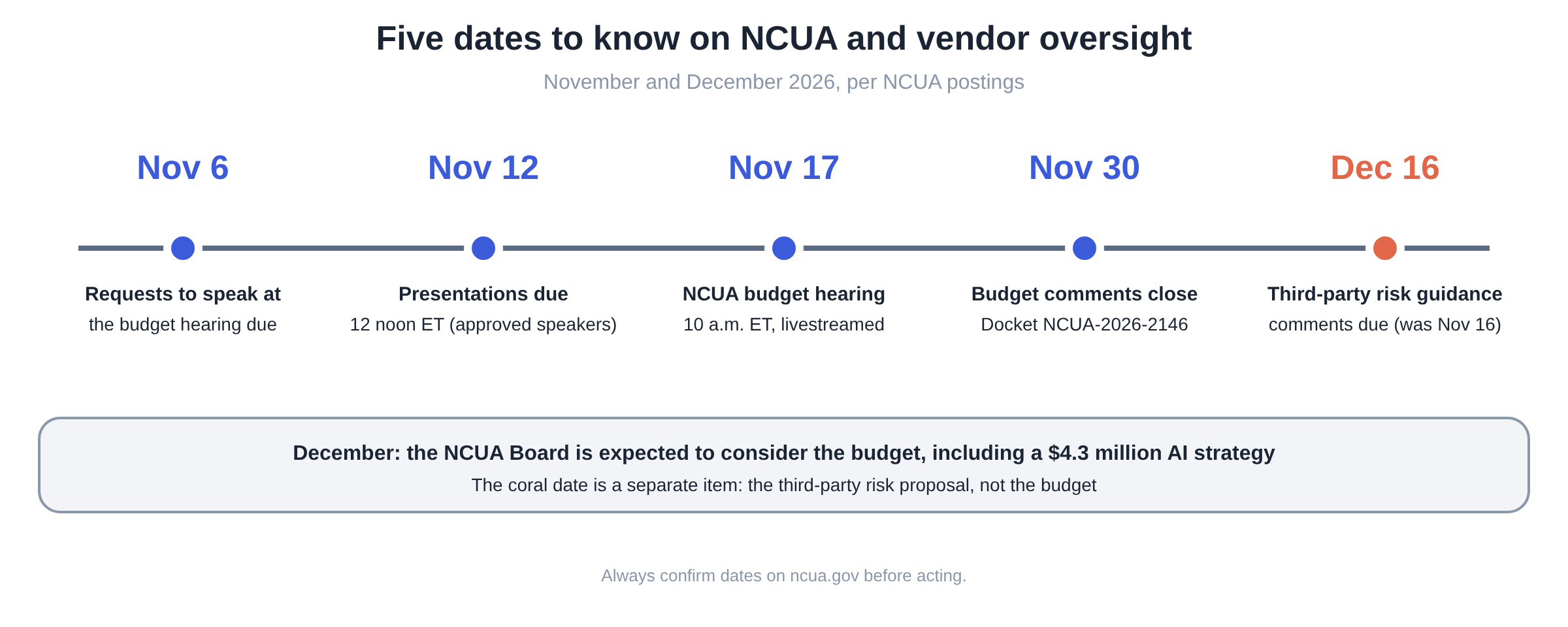
- November 6: Requests to speak at the budget hearing were due, by email to BudgetHearing@ncua.gov.
- November 12, noon ET: Presentations were due from approved speakers.
- November 17, 10 a.m. ET: The NCUA budget hearing was held at the agency's Central Office and livestreamed.
- November 30: Comments on the budget close, on Docket NCUA-2026-2146 at regulations.gov.
- December 16: Comments due on the proposed third-party risk management guidance, extended from November 16 in a November 13 NCUA release. This one is separate from the budget.
- December: The NCUA Board is expected to consider the budget.
Dates can shift, so confirm them on ncua.gov before you act. If you have a view on how the agency should spend on AI, the comment docket is the place to share it through November 30.
The takeaway
Credit unions have spent two years working out how to examine AI vendors. Now the examiners are working on their own AI. We can't say how or when that changes exam practice, and anyone who claims to know is guessing. What we can say is that the basics don't change: know what your tools do, know who owns them, and know how to turn them off.
This is general information, not legal advice. Your counsel and compliance team should confirm what applies to your credit union.
Sources