Regulators Are Asking Banks One Awkward Question About AI Agents: Can You Turn It Off?
Imagine you've put an AI agent to work. It answers members, drafts reports, maybe touches a record or two. Now imagine an examiner asks a simple question: "How would you shut it down?"
If your honest answer is "we'd call the vendor," that's worth fixing before anyone asks.
According to Reuters reporting from October 13, that question is already being asked, quietly, of banks.
What's being reported
Reuters, citing people familiar with the inquiries, reported that the Federal Reserve, the OCC, and the FDIC are putting written and verbal questions about AI to large, midsize, and smaller banks. The agencies declined to comment, and no public document has been issued. The sources described it as information gathering, not new expectations. Regulators haven't started prescribing practices.
That's an important point, so we'll say it plainly: this is not a rule. It's a look at what banks are actually doing.
The questions
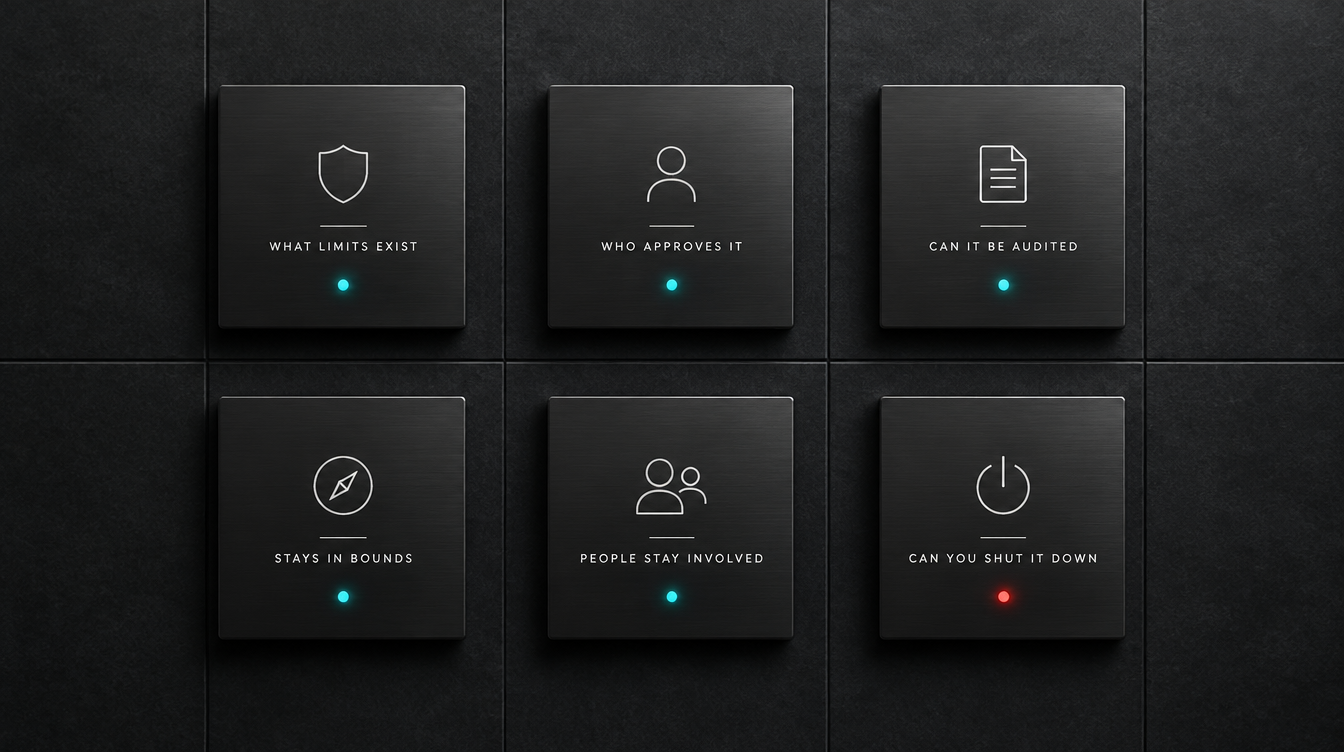
Per the sources, supervisors are asking things like these:
- What limits are set on AI systems?
- Who monitors and approves what they do?
- Can the bank track and audit the decisions its agents make?
- What keeps an agent within its authority?
- Do people stay involved in key decisions?
- How would the bank shut autonomous systems down?
Three of the sources also said regulators asked whether banks use Chinese-developed technology and whether they use AI agents in cyber defense. Reuters didn't report any bank's answers, including on the shutdown question.
Why a credit union should care
The reports name the Fed, the OCC, and the FDIC. They don't mention the NCUA. And as we covered earlier, the NCUA has no standalone AI rule.
But two things point the same way. First, the NCUA joined the other three agencies in the September third-party risk proposal, so vendor oversight is a shared concern. Second, examiners tend to ask similar questions across institutions. When a supervisor has asked a bank "how would you shut this down," it's reasonable to expect a credit union exam to get there eventually. We can't say when or how, and we'd rather be upfront about that.
Here's the useful part. The six questions are good questions whether or not anyone is asking them.
Two dates and one missing document
- December 16: Comments are now due on the proposed third-party risk management guidance. The agencies extended the period from November 16, according to an NCUA release dated November 13. The proposal is non-binding. The NCUA page points to document NCUA-2026-1684-0001 on regulations.gov.
- Still missing: The request for information on AI and model risk that the agencies promised in April had not appeared in the Federal Register as of October 24, according to ComplexDiscovery's summary of the Reuters story. Check the Federal Register before you assume that's changed.
A signal from abroad
On November 2, the Hong Kong Monetary Authority opened Project SAGE, with a discussion paper on governing agentic AI in banking. It asks banks to name a person accountable for each AI agent that can plan and act, and to identify which agents are significant enough for the regulator to see. Responses are due before February 1, 2027, and the paper says it creates no new obligations. It's Hong Kong, not the US, but it shows where supervisors are thinking: one agent, one named owner.
How to build your one-page answer
You don't need a big program. You need four things you can point to.
- Limits. For each AI tool, write down what it can see and what it can do. Start with the narrow version and widen it on purpose.
- An owner. One named person per tool who can pause it and knows how. A team inbox doesn't count.
- An audit trail. Be able to show what the tool did, when, and on whose behalf. Ask vendors for the logs, and look at them.
- A way to shut it down. Know exactly how to switch each tool off, how long it takes, and who has the authority to do it at 2 a.m. Then actually test it.
That last step is the one most people skip. A shutdown you've never practiced is a hope, not a control.
What to do this week
- List every AI tool in use, including features a vendor quietly added to something you already own.
- Next to each, write the owner's name and the shutdown step.
- Run one shutdown drill on a low-risk tool and time it.
- Decide whether to comment on the third-party risk proposal before December 16.
- Add "can we turn it off, and who decides" to your vendor questions. Our guide to vetting AI vendors has a longer list.
One more thing worth remembering. Fed Vice Chair for Supervision Michelle Bowman has said supervisory guidance "should not be a barrier for banks to engage with new and evolving tools and technologies." The message isn't "don't use AI." It's "know how you'd stop it."
Sources
- US bank regulators ask whether lenders can stop their AI agents (ComplexDiscovery, summarizing Reuters)
- Agencies extend comment period on proposed third-party risk management guidance (NCUA)
- Project SAGE asks banks to name an owner before an agent acts (The Industry Spread)
- Agencies seek comment on proposed third-party risk management guidance (Federal Reserve)