One Credit Union Started Its AI Agent With Account Balances. It May Be the Smartest Move of the Year
Most AI announcements in financial services sound enormous. Transform the member experience. Reinvent the contact center. Then you look closer and nothing has shipped.
So it's worth pausing on a smaller story, reported October 27 by iTnews. Southern Cross Credit Union, in Australia, put an AI voice agent on its phone lines. The agent, called Nova, has one job: tell members their account balance.
That's it. And that's the lesson.
What they actually did
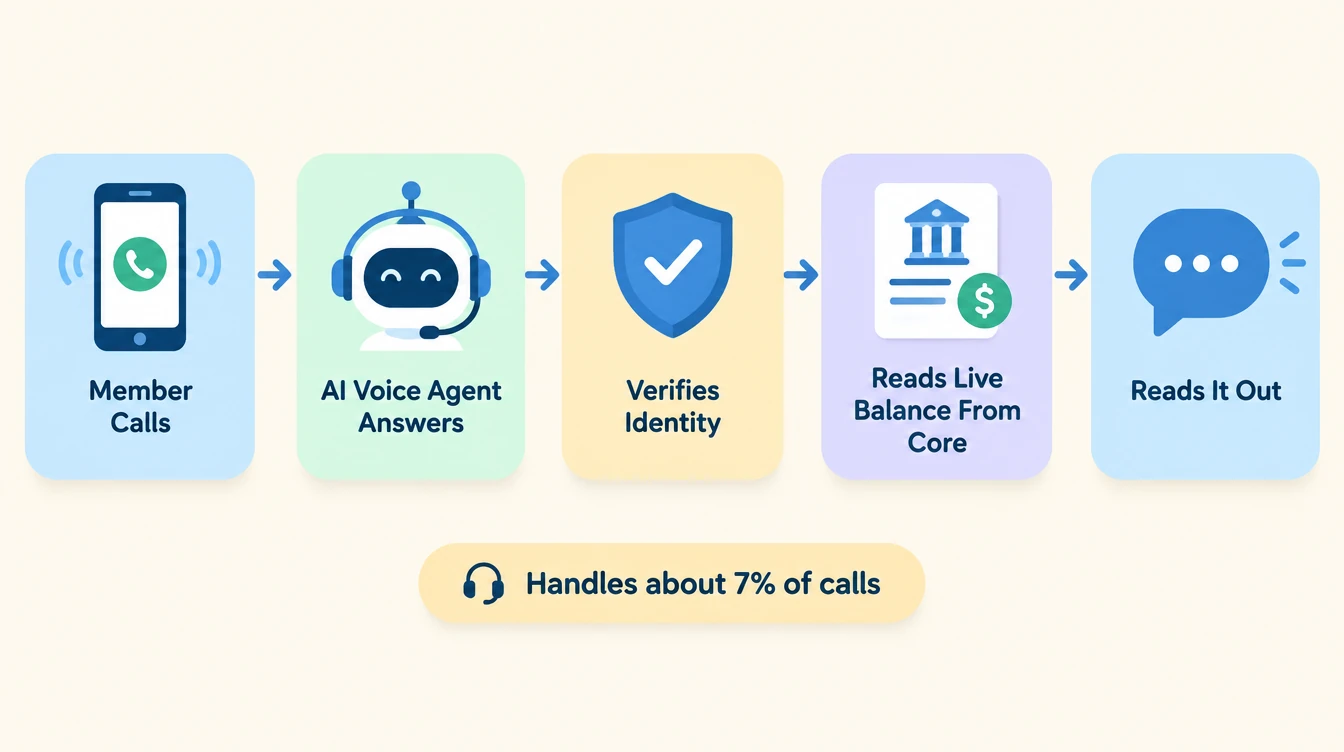
According to the iTnews report, Nova is built mainly on Salesforce's Agentforce Voice, and the credit union and Salesforce built and deployed it in about six weeks. When a member calls, the agent identifies and verifies them through the credit union's Salesforce platform, then connects to the core banking system to read out a real-time balance.
It had been running for a couple of months at the time of the article. Right now it only handles balance inquiries. A website chat agent for simple questions like branch hours is planned next.
Why the results are worth noticing
Two numbers stand out, and both come from a Salesforce case study as described by iTnews, so treat them as the vendor's account.
- Nova handles about 7 percent of all calls to the credit union.
- Before it launched, average wait times had crept up from under two minutes to nearly eight minutes, and sometimes longer.
Seven percent doesn't sound like much. But balance requests are the calls nobody on your team needs to take, and removing them frees people for the conversations that need a human. The credit union's chief customer officer said members have reacted positively.
Why "boring" is the right first step
Look at what makes balance inquiries a good starting point.
- It's a read, not a write. The agent looks something up. It doesn't change a record or move money.
- The answer is a fact. There's one right balance, and the core system holds it. The agent doesn't have to make anything up.
- It's easy to measure. You can count the calls, the wait times, and the complaints.
- The risk is contained. If something goes wrong, the failure is small and obvious.
Compare that with the more ambitious pitch you may hear this fall, where an agent handles disputes, loan questions, or account changes. Those can come later, once you've seen how the first one behaves.
What to copy, and what to ask
If you're thinking about a similar project, here's a short list.
- Pick a single, factual task. Balances, branch hours, card status, or routing numbers are all good candidates.
- Decide how the member is verified before anything is shared. In the Southern Cross example, verification runs through the platform before the balance is read out. Ask any vendor exactly how that works for your members and your core.
- Define the handoff to a person. The iTnews piece doesn't describe what happens when a caller needs more than a balance, and that's the question to settle before launch.
- Measure before and after. Capture call volume and wait times for a few weeks first, so you can tell whether it helped.
- Expand slowly. Add one new task at a time and review the results before the next.
The article also doesn't describe safeguards beyond identity checks, so we can't say how the credit union handles things like call recordings, data retention, or monitoring. Those belong on your own list of vendor questions. Our guide to vetting AI vendors has a full set, and our recent piece on MCP explains why connecting an assistant to your core should be done through controlled, read-only tools first.
The takeaway
The credit unions that learn the most from AI this year probably won't be the ones with the biggest announcements. They'll be the ones that picked one small job, measured it honestly, and then picked the next one.
Sources