More Time to Comment: What the Third-Party Risk Proposal Changes, and a Few Things Worth Telling the NCUA
Update, November 13: The agencies extended the comment period. Comments were originally due November 16 and are now due December 16, 2026, according to an NCUA release dated November 13. The release doesn't give a reason. If you saw an earlier version of this post with the November date, that's the change.
If you've been meaning to weigh in on the third-party risk proposal, you now have an extra month. The docket is NCUA-2026-1684-0001 on regulations.gov.
You don't need to write a legal brief. A short, specific comment from a practitioner is exactly what these dockets are for. Here's the proposal in plain terms.
What the proposal is
On September 11, the FDIC, the Federal Reserve, the OCC, and the NCUA jointly proposed new guidance on managing risk from third-party relationships. It would replace the 2023 interagency guidance. It's principles-based and, like all supervisory guidance, non-binding. One law firm summary quotes the proposal as saying that non-compliance won't by itself lead to supervisory action. We're relying on law firm summaries here, so read the proposal itself before you comment.
What changes
According to those summaries:
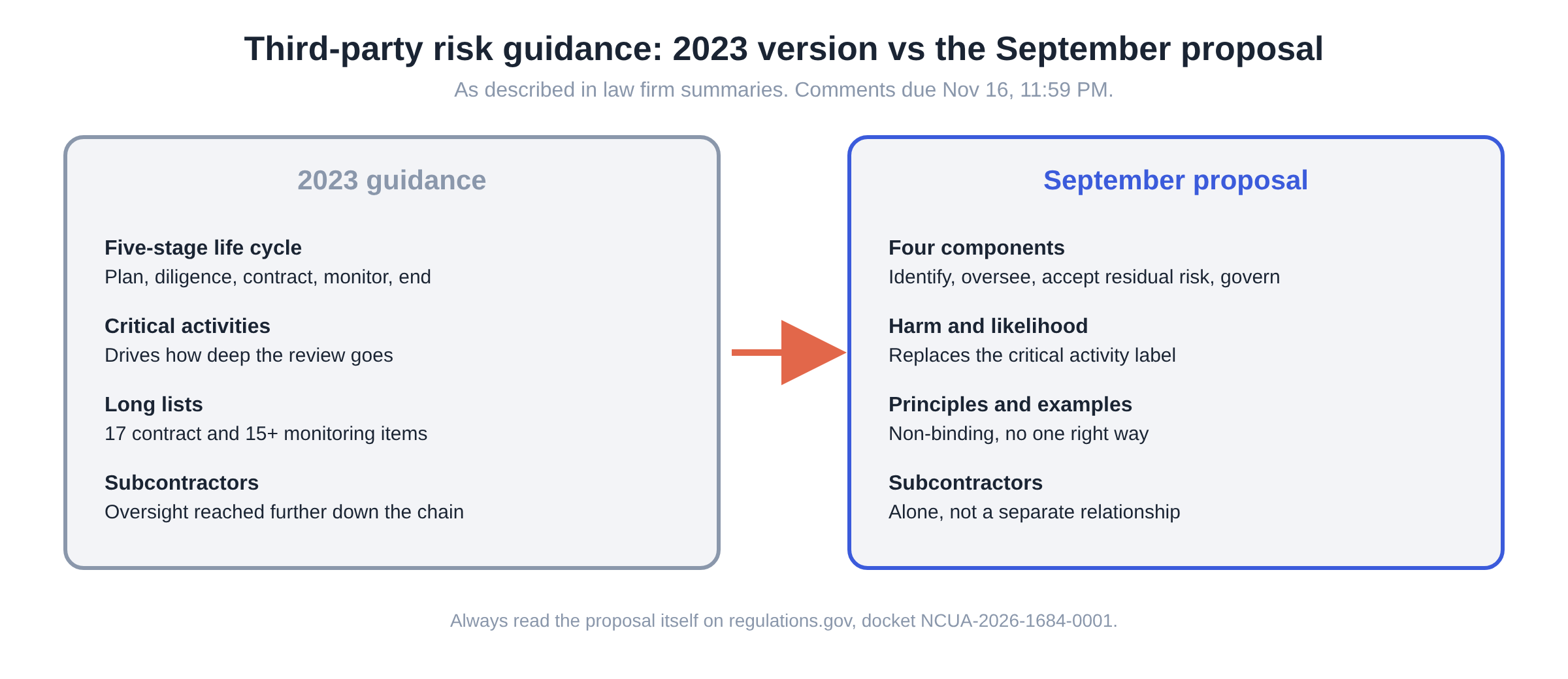
- A simpler frame. The five-stage life cycle gives way to four components: identify and assess risk, oversee it in proportion to its significance, make informed decisions about the risk that remains, and set up governance.
- No more "critical activity" label. Oversight would scale to the likely size of harm and how likely it is, rather than to a category.
- Shorter lists. The detailed checklists in the 2023 version, reportedly 17 contract items and more than 15 monitoring factors, are replaced with high-level principles and examples.
- Subcontractors. The proposal says using subcontractors alone doesn't typically create a separate third-party relationship, and it wouldn't presume direct oversight of them.
- Fintech partners. Working with fintechs and newer providers wouldn't be treated as inherently riskier.
There's also a companion guide for community banks and a joint statement on core service providers. Those were described in the summaries we read in terms of banks, and we couldn't confirm how they apply to credit unions, so check that before you assume.
Why this matters for AI
The summaries we read don't mention AI. That's a gap worth noticing, and it's where credit unions could add something useful.
Think about how most AI tools reach you. You contract with a vendor, and that vendor often runs on someone else's model underneath. Under the proposal as described, that underlying provider is a subcontractor, and subcontractors alone don't create a separate relationship. For many products that's a reasonable rule. For a tool that writes to members or acts on your records, you'd still want to know whose model is doing the work, where your data goes, and how a change on their end reaches you.
That's our reading, not the NCUA's. But it's a fair thing to ask them to clarify.
What you could say in a comment
Pick one or two points and say them plainly. A few ideas:
- Support or challenge the shift from checklists to risk. Will your examiners treat a short, reasoned file as acceptable? Say what would help you.
- Ask how AI vendors fit. Does the NCUA expect a credit union to know which model provider sits underneath a vendor's AI feature?
- Ask for credit union examples. The principles are written broadly. Examples of proportionate oversight for a small credit union would be more useful than more principles.
- Say what your vendors can and can't give you. If you struggle to get audit reports or model change notices, describe it.
Keep it short, give a real example from your own work, and don't share anything confidential. Check the docket page for how to submit.
Try it yourself: use AI to draft your comment in 30 minutes
AI is useful here as an editor, not an author. Your examples are what make a comment worth reading, and only you have them. Here's a quick hands-on way to do it.
First, jot down three or four rough bullets in your own words: one real vendor review problem, what slowed you down, and what would have helped. Then use an approved AI assistant with a prompt like this:
I am a credit union staff member writing a public comment to the
NCUA on proposed third-party risk management guidance. Turn my
notes into a clear comment of about 250 words.

Rules:
- Use only the points in my notes. Do not add facts, statistics,
  or legal claims.
- Plain, respectful tone. Start with one sentence on who I am
  and what I support or question.
- End with one specific request to the agencies.
- After the draft, list anything in it you were unsure about.

My notes:
[paste your bullets here]
Then do three things before you submit. Read the proposal sections your comment refers to and make sure you described them correctly. Remove anything that identifies a member, an employee, or a vendor you wouldn't want named. And get your compliance team to look it over.
A second quick exercise is to paste the public text of the proposal and ask for "a one-page summary for our board, with a list of questions it leaves open." It's a helpful way to see where the guidance is vague. Just remember that a summary is not the document, and the docket page is the source of truth.
Other dates this month
The NCUA's separate budget process continues. The budget hearing was held November 17 at 10 a.m. ET and livestreamed, and comments on the budget close November 30. That's a different item from the third-party risk proposal, so keep them straight. Confirm all dates on ncua.gov.
This week
- Read the proposal summary and decide whether you'll comment.
- Pull two or three real examples from your own vendor reviews.
- Check whether your vendor policy leans on the "critical activity" label, since the proposal would drop it.
- Put the new December 16 deadline on your calendar now, and block an hour well before it.
This is general information, not legal advice. Your counsel and compliance team should confirm what applies to your credit union.
Sources
- Agencies extend comment period on proposed third-party risk management guidance (NCUA)
- Agencies seek comment on proposed third-party risk management guidance (Federal Reserve)
- Banking agencies, NCUA TPRM guidance (Davis Wright Tremaine)
- Overhauled Third-Party Risk Management Guidance: What Banks and Their Vendors Need to Do Now (Duane Morris)
- Public budget hearing set November 17 (NCUA)