What Are Credit Unions Actually Using AI and Automation For Today?
"Are credit unions using AI?" is the wrong question. Nearly all of them say yes. The better question is how much of it is actually running, and where.
What the surveys say
Two 2026 surveys give a useful picture, and they measure different things, so it helps to read them side by side.
- Starting. A Wipfli survey of 100 credit union executives, published in January, found 79% were researching or implementing AI. That is a measure of interest and early work, not of finished deployments.
- Implemented in some areas. A PYMNTS Intelligence tracker from January found about 42% of credit unions had implemented AI in specific areas, and only about 8% across multiple facets of the business. That tracker was industry-sponsored research, so look at the pattern more than any single number.
- Still learning. In the same tracker, about half of leaders said they were only somewhat familiar with AI applications, and just 17% described themselves as very familiar.
- The barrier they name. In the Wipfli survey, 60% said data readiness, quality, and governance is their top barrier to using AI.
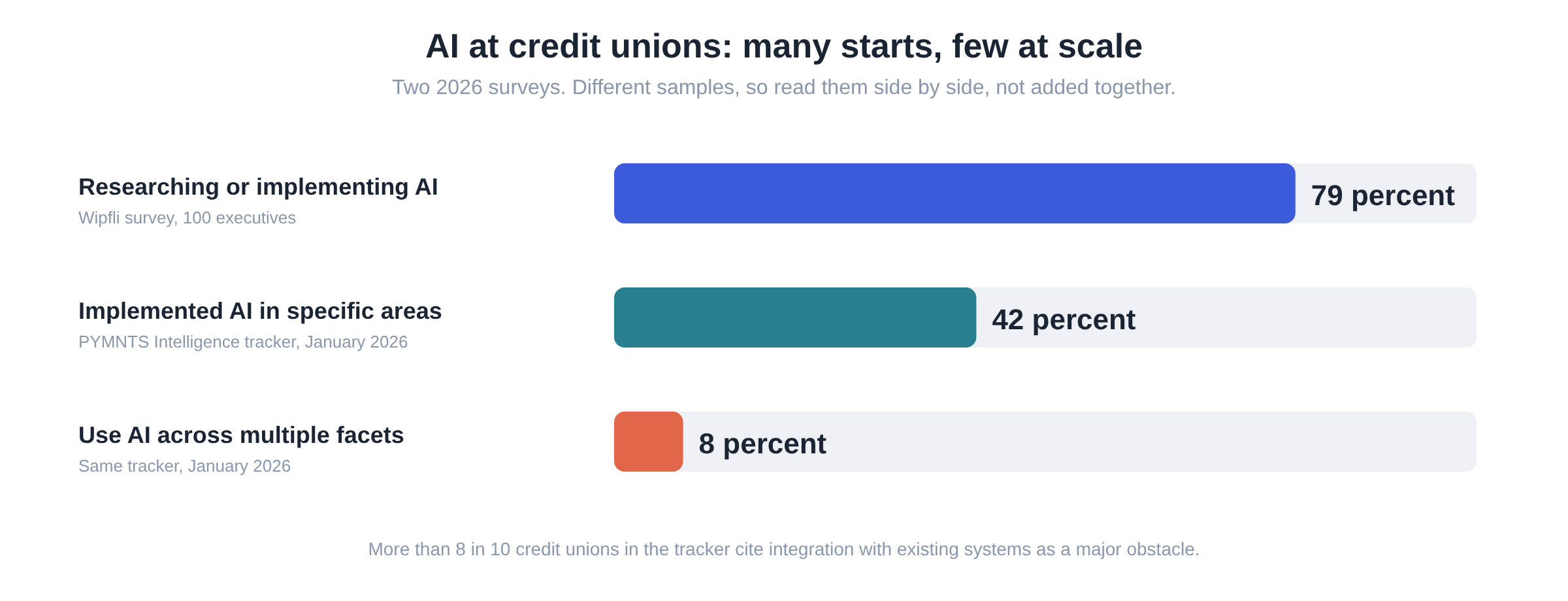
The shape is the story. Lots of starts, some working tools, very little at scale.
Where the use is concentrated
The Wipfli survey found that most AI use is operational and behind the scenes: fraud detection, financial reporting, and risk analysis. Wipfli attributes the high adoption figure to vendor tools already embedded in platforms credit unions run, and one of its directors puts it bluntly, saying many credit unions are using AI because it is available rather than because it is part of a deliberate strategy. That fits what we hear from practitioners. The early wins tend to be places where the output is checked by a person and the data already exists.
Common examples include:
- Fraud and anomaly alerts. Pattern checks on card, ACH, and account activity, with an analyst reviewing what is flagged.
- Member service support. Drafting replies, summarizing calls, and finding policy answers for staff, rather than talking directly to members.
- Reporting and analysis. Help writing queries, building summaries, and explaining variance for finance and risk teams.
- Document handling. Pulling fields out of forms and statements so staff spend less time keying data.
- Process automation. Routing, status updates, and exception lists that used to be built by hand each week.
Process automation also appears on the Wipfli priority list, alongside digital member engagement, data analytics and AI, instant payments, and banking as a service.
Automation versus AI
These two get blended together, and the difference matters when you talk to your board.
Automation follows a rule you wrote: if the balance is over this amount, send it to review. It is predictable and easy to audit.
AI handles messy input, like reading a document, summarizing a call, or drafting a message. It is flexible and sometimes wrong.
Most of the useful work today pairs them: rules decide, AI helps explain or draft, and a person approves. Our next post builds exactly that.
What is holding it back
The PYMNTS tracker found that more than 8 in 10 credit union leaders cite integration with existing systems as a major obstacle, and that data quality, governance, and connectivity are the main constraints. Wipfli's write-up also says 77% of respondents reported at least one incident of unauthorized access to networks or data in the last 12 months, a reminder that security sits right next to every AI conversation. Note that the key findings panel on the same page gives 60% for a similarly worded item, so check which question you are quoting before you put a number in a board deck.
None of that says AI does not work. It says the plumbing and the rules come first. The Filene Research Institute makes a similar point: the challenge is not that credit unions lack data, it is that data remains siloed, mediated, and slow to activate.
A fair reading for your own credit union
If you are behind the 8%, you are in the large middle, not the back of the pack. The useful comparison is not against a survey. It is against your own list of manual, repetitive work that a person already reviews.
Try it yourself: take a one-hour inventory
This is a good first hands-on exercise for a data or operations analyst, and it needs no member data.
Ask three or four colleagues to list the recurring tasks that eat their week: weekly lists, copy and paste reports, form review, status emails. Then use an approved AI assistant with a prompt like this:
Below is a list of recurring tasks at a credit union. For each
one, say whether it is best handled by (a) a simple rule-based
automation, (b) an AI-assisted draft that a person reviews, or
(c) neither. Give one sentence of reasoning and name the data it
would need. Do not assume access to any system I have not listed.

[paste your task list]
Treat the answer as a starting sort, then argue with it. The tasks that land in (a) or (b) and already have clean data are your first candidates.
The takeaway
The honest state of play is a lot of curiosity, some narrow tools in production, and little broad use. That is a fine place to be if you pick one workflow, keep a person in the loop, and write down what the tool does.
Sources
- Executive summary: The state of the credit union industry research report 2026, January 27, 2026 (Wipfli)
- The state of the credit union industry 2026 research report, full report (Wipfli)
- Critical Moment: The AI Imperative for Credit Unions, January 2026 Credit Union Tracker (PYMNTS Intelligence)
- Credit Unions See AI's Promise, but Readiness Lags Adoption, January 20, 2026 (PYMNTS)
- Data-Driven Finance: From Core Systems to Intelligent Agents, Lamont Black, April 22, 2026 (Filene Research Institute)